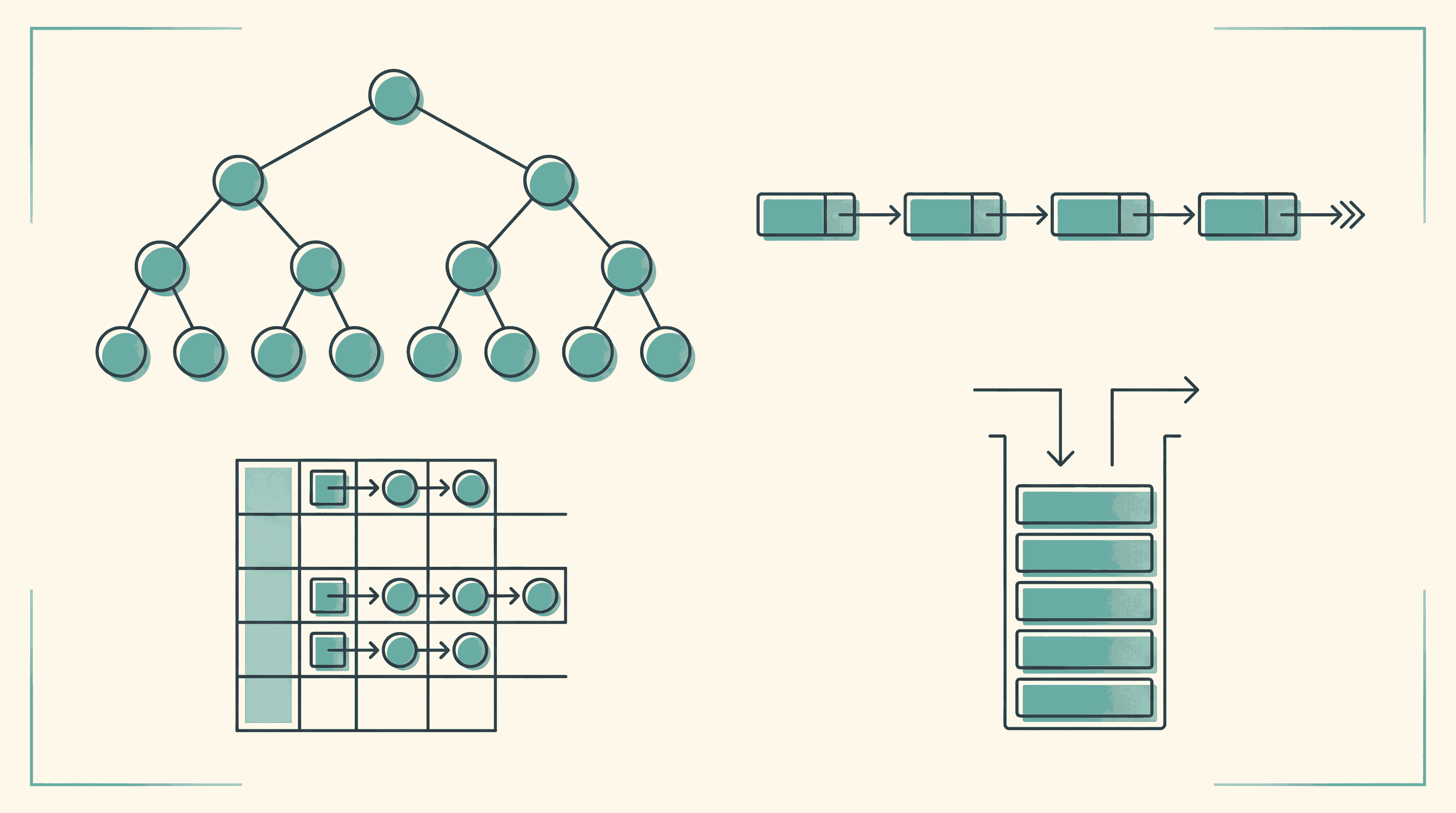
- data structures interview cheat sheet checklist you can use in your next interview
- A simple framework to keep your answer structured and scorable
- A practice plan you can repeat until it feels natural out loud According to LinkedIn's Talent Blog, structured preparation improves interview performance by making your answers easier to evaluate.
TL;DR: data structures interview cheat sheet becomes easier when you use a clear structure, measurable proof, and a short practice loop.
Key Takeaways:
- A data structures interview cheat sheet is about choosing the right tool, not memorizing APIs.
- Use CORE: Capabilities → Operations → Runtime/space → Edge cases.
- Interviewers grade your tradeoffs and invariants as much as your final code.
- Practice explaining choices out loud so your reasoning is scorable.
What is data structures interview cheat sheet? It’s a compact reference that helps you choose data structures quickly by mapping operations to costs, patterns, and edge cases.
When people fail data structures interview cheat sheet questions, it’s rarely because they don’t know what a hash map is. It’s because they can’t connect operations to complexity under interview constraints: “I need fast membership checks,” “I need ordered traversal,” “I need to pop the max repeatedly,” “I need prefix lookups.”
According to the U.S. Bureau of Labor Statistics, overall employment of software developers is projected to grow 15% from 2024 to 2034 (BLS). More roles means more interviews—and data-structure choice is one of the most common differentiators between “can code” and “can reason.”
Data structures interview cheat sheet: the CORE map
CORE is the simplest way to explain your choice quickly. It also prevents the common failure mode: jumping into code without stating what operations matter.
CORE:
- Capabilities: what does this structure give you (ordering, uniqueness, priority)?
- Operations: what do you need (insert, delete, lookup, min/max, range query)?
- Runtime/space: what’s the expected and worst-case cost?
- Edge cases: duplicates, empty, overflow, collisions, invalid indexes.
If you want a consistent interview loop around this, combine CORE with the coding interview tips: think → talk → code → review.
Data structures interview cheat sheet: quick decision table
Start with the operation you need most. Then pick the simplest structure that supports it.
- Need fast membership / key→value lookups → hash map / set
- Need ordered traversal / sorted keys → balanced tree map (or sort once + array)
- Need top-k repeatedly → heap / priority queue
- Need FIFO processing → queue / deque
- Need LIFO with backtracking → stack
- Need prefix search → trie (or sort strings + binary search)
- Need range sums / updates → Fenwick tree / segment tree (advanced)
💡 Pro Tip: The best data structures interview cheat sheet answer is often “array + sorting,” because it’s simple and predictable—if it meets the constraints.
Data structures interview cheat sheet: CORE in 15 seconds (an example)
If you can do CORE quickly, you’ll sound calm and senior even on unfamiliar prompts.
Example prompt: “Return the top k most frequent words.”
- Capabilities: we need counting + ordering by frequency.
- Operations: update counts per word, then repeatedly extract highest frequency.
- Runtime/space: hash map counts is O(n); heap extraction is O(m log m) or O(m log k) depending on approach.
- Edge cases: ties, punctuation/case normalization, k > unique words.
Notice what you didn’t do: you didn’t start coding. You made the grading criteria obvious first. That’s the real purpose of a data structures interview cheat sheet.
Data structures interview cheat sheet: arrays and strings
Arrays are the default because they’re cache-friendly and simple. They’re also the easiest place to make off-by-one mistakes.
When arrays win:
- Index-based access (i, i±1)
- Two pointers
- Sliding window
- Sorting then scanning
Common edge cases:
- Empty array
- Single element
- Duplicate values
- Overflow in sums (use long types when needed)
Data structures interview cheat sheet: hash maps and sets
Hash maps trade memory for speed. In interviews, you’ll use them for counting, grouping, and membership.
Patterns:
- Frequency map (anagrams, counts, windows)
- Seen set (detect duplicates, cycle detection)
- Index map (two-sum style)
Tradeoffs to mention:
- Expected O(1), worst-case O(n) if hashing degrades
- Memory overhead
- Key choice (string vs tuple vs integer encoding)
Data structures interview cheat sheet: stacks
Stacks are about enforcing an invariant. Most strong stack solutions are “monotonic” or “matching.”
Patterns:
- Parentheses matching / delimiter parsing
- Monotonic stack (next greater element, histogram)
- Undo/backtracking (DFS recursion analog)
Edge cases:
- Empty stack pops
- Equal values in monotonic stacks (define strictly vs non-strictly)
Data structures interview cheat sheet: queues and deques
Queues model “work that arrives over time.” Deques are queues with both-end operations.
Patterns:
- BFS level order traversal
- Sliding window maximum (deque with monotonic property)
- Multi-source BFS
Tradeoffs:
- Array-backed queue implementation details (head index vs shift)
- Deque complexity vs heap alternative
Data structures interview cheat sheet: heaps (priority queues)
Heaps answer “give me the next best thing” efficiently. They’re perfect for top-k and scheduling.
Patterns:
- Maintain k largest/smallest elements
- Merge k sorted lists
- Scheduling with earliest finish time
Tradeoffs:
- O(log n) per push/pop
- Heaps don’t support fast arbitrary delete (without extra indexing)
Data structures interview cheat sheet: trees (BST) and tries
Trees are for order and structure. Tries are for prefix queries.
BST / tree map is useful when you need:
- Ordered iteration
- Range queries
- Successor/predecessor
Trie is useful when you need:
- Prefix lookup
- Autocomplete-style queries
⚠️ Warning: Many candidates reach for a trie too early. If n is small, sorting strings and using prefix checks can be simpler and easier to debug.
Data structures interview cheat sheet: 6 patterns and the structure that wins
Most interview questions are just patterns wearing different prompts. This data structures interview cheat sheet becomes useful when you can map the prompt to one of these patterns quickly.
-
Count + compare: “Are these anagrams?” / “Most frequent elements?”
Use: hash map for counts, then a heap or bucket approach for top-k. -
Window with constraint: “Longest substring with at most k…”
Use: hash map for counts + two pointers; the invariant is “window always valid.” -
Next greater / monotonic property: “Next warmer day” / “largest rectangle”
Use: monotonic stack; define whether equal values pop or stay. -
Top-k streaming: “Keep top 10” / “kth largest so far”
Use: min-heap of size k; every push may pop. -
Connectivity / shortest path: “Minimum steps” / “connected components”
Use: queue for BFS, set/map for visited; avoid recursion depth issues when needed. -
Prefix search / autocomplete: “Find words starting with…”
Use: trie if scale demands it; otherwise sort strings and binary search prefix ranges.
If you want to turn this data structures interview cheat sheet into a schedule, follow the pattern-based cadence in the leetcode study plan 3 months.
What should you say when asked “why did you choose this data structure?”
Say the operations and the costs. This is the core of a good data structures interview cheat sheet explanation.
Use this sentence template:
- “I need fast X operations, and this structure gives me Y time complexity with acceptable memory overhead.”
Example:
- “I need frequent membership checks, so a set gives me expected O(1) lookups.”
- “I need to repeatedly take the minimum, so a heap gives me O(log n) pops.”
- “I need ordered traversal, so I sort once and scan; that’s O(n log n) upfront with O(1) per step.”
Compare block: weak vs strong data structure explanation
❌ Weak Answer: "I used a hash map because it’s fast and I always use it for these problems."
✅ Strong Answer: "The key operation is membership + counting within a window. A hash map gives expected O(1) updates per step, and the window invariant stays easy to maintain."
Callout: the invariant rule
💡 Pro Tip: In most DSA questions, correctness comes from one invariant. Before coding, state the invariant in one sentence. If you can’t, your data structure choice is probably unclear.
Frequently Asked Questions
How do I memorize a data structures interview cheat sheet quickly?
Don’t memorize. Practice mapping prompts to operations: “top-k,” “ordered,” “window,” “prefix,” “connectivity.” Then pick the simplest structure that supports it.
What if I choose the “wrong” data structure?
Explain tradeoffs and adjust. Interviewers often give partial credit for reasoning even if your first choice isn’t optimal.
How should I practice data structures interview cheat sheet skills?
Use short timed reps and speak your reasoning. The mock interview practice guide helps you train clarity and pacing, not just correctness.
Practicing with a human interviewer on LeetCodeMate is especially useful for this topic because you get feedback on whether your data-structure choice and invariant are actually clear to someone else.
Key Takeaways
- Use CORE to justify data structure choices: capabilities, operations, costs, edge cases.
- Map prompts to operations first; then pick the simplest structure that works.
- State an invariant before you code and test it with examples.
- Practice explaining tradeoffs out loud to score higher.
Ready to practice your data structures interview cheat sheet decisions with a real interviewer? Book a free mock interview on LeetCodeMate → and get personalized feedback from engineers who've interviewed at FAANG companies.
Weak vs Strong: data structures interview cheat sheet
Weak Answer
I would approach it generally and hope it lands. I don’t have a clear structure and I can’t point to a concrete result.
Strong Answer
I use a clear structure, state what I owned, and prove impact with one metric. I keep it concise and role-aligned.
The strong answer is scorable: structure, ownership, evidence, and clear fit.
If you want related practice, read a complementary interview prep guide and another framework you can reuse.
The fastest way to improve is hearing how your data structures interview cheat sheet answer lands with an experienced interviewer—Start Practicing Free and get scored feedback.
Ready to practice?
Book a mock interview session and get targeted feedback.